Walk up to an active blackjack table in any casino, and the first thing you notice is the speed. Cards snap across the felt, chips slide in clean stacks, and players communicate through subtle hand gestures and crisp one-word declarations. To a newcomer, the rhythm feels almost choreographed, and the specialized vocabulary can sound like a foreign dialect.
Blackjack has earned its reputation as the most player-friendly table game in the building, largely because smart decision-making directly curbs the house edge. Yet applying basic strategy requires understanding the precise language of the felt. Misinterpreting a dealer prompt or confusing table terminology can lead to costly mistakes before you even realize you made the wrong move. Whether you plan to sit down at a high-energy brick-and-mortar casino or play at an online live-dealer table, mastering the fundamental lexicon gives you the poise to play each hand with clarity.
The Core Actions: Directing Your Hand
Every round of blackjack revolves around a handful of fundamental actions. While you can speak your intentions aloud, physical hand gestures govern live casino play so overhead surveillance cameras can verify your choices.
A hit is a request for an additional card to increase your total. At a shoe game where cards are dealt face-up, tapping the felt with a finger signals a hit. If that additional card pushes your cumulative hand total past 21, you bust, which results in an immediate loss of your wager regardless of what the dealer eventually draws.
When you are satisfied with your card total and want to take no further action, you stand. The physical gesture is a simple horizontal wave of your hand, palm down, over your cards.
If your final hand total matches the dealer’s final total without either party busting, the result is a push. In a push, no money changes hands; your original wager stays in the betting circle for you to reclaim or let ride for the next deal.
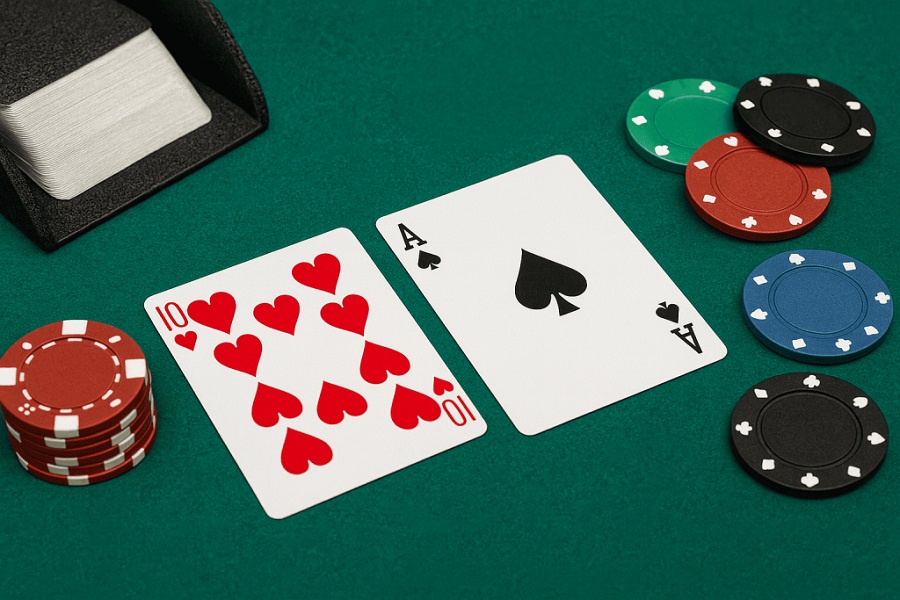
A natural, universally called a blackjack, occurs when your starting two cards consist of an Ace and any ten-value card, meaning a ten, jack, queen, or king. A natural is an automatic victory that traditionally pays 3 to 2 on your bet, unless the dealer also holds a natural, which results in a push.
Hand Configurations: Understanding the Anatomy of Totals
Not all card totals carry the same strategic flexibility. The presence or absence of an Ace fundamentally alters your room for error, creating distinct categories that dictate your mathematical response.
A hard hand is any hand that either contains no Ace at all or contains an Ace that must be valued at 1 to prevent the hand from exceeding 21. For instance, a hand of ten and seven is a hard 17. Similarly, a hand containing eight, five, and an Ace is a hard 14, because counting the Ace as 11 would bust the total to 24. Hard hands are rigid; taking a hit on a hard 12 through 16 carries an immediate risk of busting.
A soft hand contains an Ace that can be counted as either 1 or 11 without exceeding 21. An Ace and a six forms a soft 17. Soft hands provide exceptional freedom because taking a hit carries zero risk of an immediate bust. If you hit a soft 17 and draw a nine, your total does not jump to 26; the Ace instantly revalues to 1, leaving you with a viable hard 16.
Within these classifications, experienced players frequently reference two specific hand states:
-
Stiff hand: Also known as a breaking hand, this refers to hard totals from 12 through 16. These are universally awkward spots where hitting can bust you, but standing leaves you vulnerable to any decent dealer hand.
-
Pat hand: A completed total of 17 through 21 where basic strategy dictates you never draw additional cards, as the mathematical probability of improving without busting is exceptionally poor.
Expanding Your Wagers: Advanced Strategic Moves
Beyond simply hitting or standing, standard rules permit aggressive tactical adjustments depending on the dealer’s visible vulnerability.
Doubling Down and Splitting Pairs
To double down means placing a second wager equal to your original bet in exchange for agreeing to receive exactly one additional card. You typically double down when your initial two cards total 10 or 11 against a weak dealer upcard. The single card you receive is often dealt sideways across your original cards to signify that your action on that hand is complete.
A split is available whenever your initial two cards carry the exact same numerical value, such as a pair of eights or a pair of kings. By matching your original wager alongside your initial chips, you separate the pair into two distinct hands, each receiving its own second card and played independently. Splitting pairs allows you to turn a defensive position into two offensive opportunities, particularly when dividing a pair of eights, which converts a weak hard 16 into two fresh starting hands of eight.
Defensive Wagers and Early Exits
Surrender is a defensive rule permitting a player to forfeit their hand before drawing cards, surrendering half of their wager while recovering the other half. It is an invaluable mathematical escape hatch when holding a terrible stiff hand against an overwhelming dealer upcard, such as a hard 16 against a dealer Ace or ten.
Insurance is an optional side bet offered exclusively when the dealer’s visible card is an Ace. The wager costs half of your original bet and pays 2 to 1 if the dealer’s facedown card is a ten-value card, protecting your stake against an immediate dealer blackjack. A related scenario is even money, offered when you hold a natural blackjack and the dealer shows an Ace; accepting even money guarantees a 1 to 1 payout on your hand before the dealer checks their hole card. While tempting to recreational players, basic strategy considers both options mathematical traps that carry an unfavorable house edge over the long haul.
Equipment and Table Architecture
Understanding the physical layout and structural rules of the table ensures you never feel out of place when the dealer runs the pit.
The dealer’s two cards consist of the upcard, which sits face-up for all players to evaluate, and the hole card, which rests face-down underneath. In American blackjack, the dealer uses a built-in optical scanner or peek mirror to check the hole card for a natural twenty-one before players act whenever the upcard is an Ace or a ten.
Cards are dealt from an acrylic dispenser known as the shoe, which generally holds between six and eight shuffled decks. During the shuffle process, the dealer inserts a colored plastic cut card into the pack. The position of this card determines penetration, which measures the percentage of cards dealt before a fresh shuffle is required. Deep penetration means more cards are played before the shuffle, a factor that holds significant weight for card counters tracking the shifting composition of the deck.
Finally, always inspect the printed felt for the table’s specific dealer drawing rules:
-
S17 (Stand on Soft 17): The dealer must stand on all totals of 17 or higher, including soft 17. This rule favors the player.
-
H17 (Hit on Soft 17): The dealer is required to hit soft 17, giving the house an extra opportunity to improve their total and marginally increasing the house edge.
Developing Fluency at the Felt
Stepping into a casino pit is far more rewarding when the proceedings feel transparent rather than intimidating. Knowing the distinction between a hard and soft total keeps your strategy sharp, while understanding terms like split, double down, and surrender allows you to execute mathematically sound plays without hesitation. When you speak the language of the game and read table conditions with accuracy, you strip away the confusion and focus entirely on making disciplined, confident decisions on every hand.